CPR West Covina Logo

The revenue nobody follows up on

Email and SMS Automation for Local Service Businesses

Two cadences pay for everything else: the quote that went quiet, and the repeat service that comes due. We write them, wire them, and run them, so the follow-up happens whether or not anyone remembers.

  • 01Abandoned quote and checkout recovery, written and running
  • 02Repeat-service reminders built off real job dates
  • 03Reported in booked jobs, not open rates
4.9 from 300+ Google and Yelp reviews on our own local service businessWe run these cadences on our own customer list

Assembly

How we build your follow-up

Six steps. Step 2 is the one people skip, and it quietly breaks every cadence after it.

6 steps

  1. Pull the list you already have

    Past customers, job dates, and every quote or checkout that stalled before payment.

  2. Fix the tracking under it

    A cadence is only as good as the event that starts it, so we verify the triggers first.

  3. Write the abandoned quote ladder

    Three touches over 72 hours, each one carrying a link back to the exact job they asked about.

  4. Build the repeat-service ladder

    Reminders timed to the service cycle, plus a win-back for customers who lapsed.

  5. Turn on SMS where it earns its place

    Appointment reminders and time-sensitive touches only, so nobody opts out over a newsletter.

  6. Run it and report on revenue

    We keep writing, sending, and pruning every month, and the report is booked jobs.

From our own account

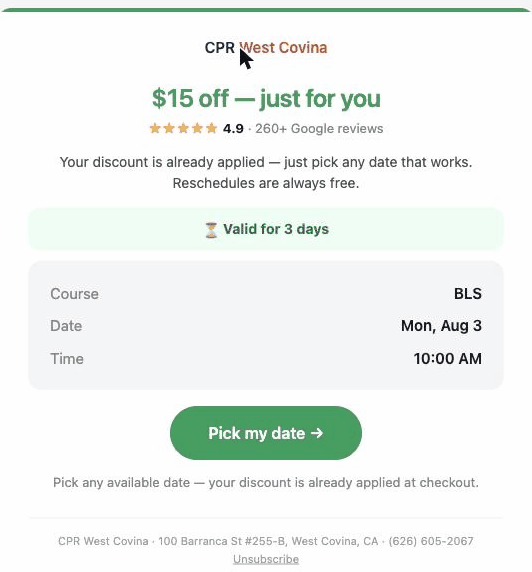
A recovery email sent by our own automation cadence
A real recovery email from our own cadence.

Contents

What you get

In the box

  • 01Abandoned quote and checkout recovery sequence, written and running
  • 02Repeat-service reminder ladder tied to each customer's job dates
  • 03Win-back sequence for customers who have lapsed
  • 04Booking confirmations, day-before and day-of reminders
  • 05Review requests timed to the moment the customer is happiest
  • 06SMS for the time-sensitive touches, email for the rest
  • 07Suppression and stop rules so a customer who rebooks stops hearing from us
  • 08Monthly report on recovered quotes and repeat bookings

Price

What it costs

Starting at

$500 to build, $250/month

Founder pricingFirst 10 clients · Prices rise Jan 2027

What’s included

  • 01Abandoned checkout cadence
  • 022-year renewal ladder
  • 03Copy written and run for you

Anything beyond the starting build gets a real quote after a 15-minute call.

Prices go up in January 2027. Book before then and your rate is locked for as long as you stay a client.

Common assembly error

Two piles of money nobody picks up

Without it

Most local service businesses have two piles of money sitting untouched. The first is the quote that went quiet: a customer asked for a price, got it, and never answered. Nobody follows up, so that job goes to whoever calls them back first. The second is bigger. Almost every local service has a repeat cycle, the tune-up, the re-treatment, the seasonal service, the annual inspection, which means you are holding a list of people with a known future purchase date, and nobody emails them.

What usually happens instead is that the service comes due, the customer searches Google, and they land on whoever is bidding that week. You paid to acquire that customer once and then handed them back to the auction. The repeat job is the cheapest booking in the business and most owners pay full ad price for it a second time.

The third failure is subtler: the follow-up exists, but it is one generic blast to the whole list. No job history, no service date, no link back to the thing they asked about. Customers unsubscribe, deliverability drops, and the owner concludes email does not work for their trade. It works. It just has to know who the person is and what they were about to buy.

Abandoned quote follow-up: what actually recovers the job

A quote is not a shopping cart, it is a decision the customer is putting off, and that changes the follow-up. The first touch goes out within an hour, while the problem is still on their mind, and it links straight back to the quote rather than your homepage. The second lands the next morning and answers the reason people stall: is this price fair, are you actually available this week, what exactly is included. The third arrives about 72 hours later and either offers to hold the slot or asks plainly whether the job is still happening. Three touches, then stop. Anything longer stops recovering and starts annoying.

How do I set up repeat-service reminder emails?

Start from the data you already have: the date each customer last had the service and what it was, which gives you a due date one season, one year, or one cycle out. Build the ladder backwards from that date rather than forwards from today. A reminder well ahead of the due date gets the planners, one close to it gets the majority, one just past it gets the procrastinators, and a win-back after that catches the people who let it slide. Every message links to booking that specific service, prefilled where possible. The single most important rule is that the ladder stops the moment they book, or you are emailing a customer about something they already bought.

Email or SMS for a local service business: which one, and when

Use each for what it is good at. Email carries anything a customer needs to read, keep, or forward: the confirmation, the quote, the invoice, the what-to-expect note. SMS carries the touches that are worthless if they arrive late: the day-before reminder, the on-my-way text with an arrival window, and the last call on a quote that is about to expire. Sending marketing over SMS is how you burn the channel, because one unwanted text costs you the number permanently. We keep SMS scarce on purpose, which is exactly why the appointment text still gets read.

Does the follow-up work if my booking system is not connected to anything?

It can, but it works better connected. The minimum we need is a reliable record of who bought what and when, which most local businesses already have in their field-service tool, their payment processor, or a spreadsheet the office keeps. From there we can compute due dates and identify stalled quotes. What connection buys you is timing and accuracy: a live trigger fires within the hour instead of the next time somebody exports a file, and a customer who rebooks drops out of the ladder immediately instead of getting one more reminder. If the plumbing is missing, we say so on the call and price the fix separately.

How much revenue is a customer list actually worth?

Do the arithmetic on your own numbers rather than trusting anyone's benchmark. Take the customers you served in the last cycle, multiply by your average ticket, and that is the pool coming due this year. Then ask what share currently comes back without being asked. The difference between that share and what a reminder ladder can reach is the entire opportunity, and it costs you nothing in ad spend to go get it. This is also the most stable revenue in a local business, because it is dateable. You know months ahead of time roughly how many jobs the repeat list should fill.

Troubleshooting

Email and SMS questions, answered

Is this software I run, or a service you run?
This page is the done-for-you version: we write the emails and texts, we build the cadences, we monitor them, and we keep changing them every month based on what books. If you have someone in-house who will actually write and watch the campaigns, tell us on the call and we will scope the handover version honestly.
Do I need a big list for this to be worth it?
You need enough past customers that the repeat pool is real. If you have served a few hundred people, the reminder ladder pays for itself quickly. If you opened last month, start with abandoned quote recovery and add the repeat ladder as the list builds.
Which email platform do you use?
Whatever you already pay for, if it can handle triggered sequences and merge fields. If you have nothing, we will recommend something cheap and boring rather than moving you onto a platform we resell. We do not take a cut of your sending tool.
Who writes the copy?
We do. You review it for accuracy on services, pricing, and scheduling, because those are the things only you know. Nothing sends until you have signed off on the sequence.
How do you keep from spamming my customers?
Frequency caps, a suppression list, and hard stop rules. If a customer books, the ladder stops. If they unsubscribe, they are out of everything. SMS is reserved for time-sensitive touches only. The goal is a list that still opens your email in two years, not a good month followed by a dead list.
Can this also ask for reviews?
Yes, and it should. The review request goes out at the moment the customer is happiest, usually right after the job closes, and it links straight to your Google profile. Reviews feed the map pack, which feeds everything else, so we treat the review cadence as part of the same system rather than an afterthought.
How do I know it is actually making money?
Every link is tagged, so a recovered quote and a repeat booking are attributable to the message that produced them. The monthly report shows booked jobs and revenue from each cadence, not open rates. Open rates do not pay technicians.
How much does email and SMS automation cost?
It is $500 to build and $250 a month to run. The build covers setting up the abandoned quote and repeat-service cadences, writing the copy, and wiring the triggers. The monthly covers running them, rewriting what is not working, and the report. You get a real quote after a 15-minute call if your setup needs data work first.

Need a hand

Find out what your customer list is worth

Book a 15-minute call. We will look at how many past customers you have, how many come back on their own today, and what the gap between those two numbers costs you a year.

We work with local service businesses nationwide