CPR West Covina Logo

Revenue recovery

Recover Bookings That Stall at Checkout

A student picked a course and a date, then closed the tab at payment. If your system only records people who pay, that student never existed. We capture them at intake and follow up with a link back to the exact class.

  • 01Booking captured before the payment step
  • 02Personalized link back to the exact course and date
  • 03Sequence stops the moment they pay
4.9 from 300+ Google and Yelp reviews on our own CPR businessBuilt by operators, not a software company

Assembly

How recovery works

Six steps. Step 1 is the one that makes the other five possible.

6 steps

  1. Capture at intake

    Name, email, course, and date are saved before payment opens.

  2. Watch for the payment

    If no charge matches within an hour, the booking is stalled.

  3. First nudge, same day

    A short email with a link back to that exact session.

  4. Second touch, next day

    Seats remaining on their date, and one clear button.

  5. Final touch with an offer

    A discount link, only after the plain reminders failed.

  6. Stop on booking

    Any completed payment cancels the rest of the sequence.

From our own account

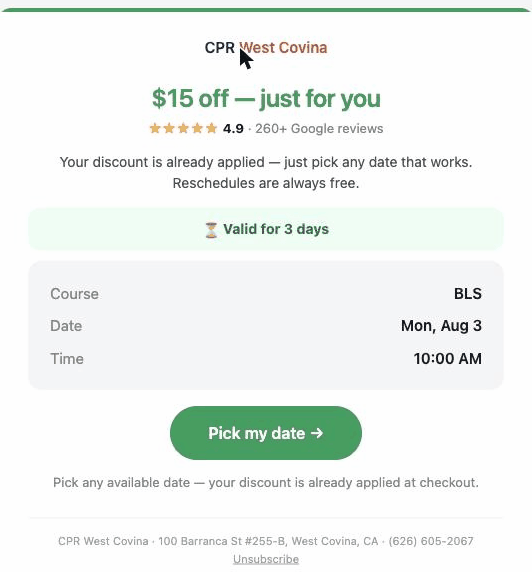
An abandoned checkout recovery email with a discount link
A real recovery email with its discount link.

Contents

What you get

In the box

  • 01Lead capture before the payment step
  • 02Stalled-booking detection within the hour
  • 03Three-touch recovery email sequence
  • 04Personalized link back to the exact class and date
  • 05Optional discount code on the final touch
  • 06Automatic stop when payment completes
  • 07Owner notification at intake, not at payment
  • 08Reporting on bookings recovered per month

Price

What it costs

Starting at

$500 to build, $29/month

Founder pricingFirst 10 clients · Prices rise Jan 2027

What’s included

  • 011 follow-up email
  • 02Personalized rebooking link

Anything beyond the starting build gets a real quote after a 15-minute call.

Prices go up in January 2027. Book before then and your rate is locked for as long as you stay a client.

Common assembly error

She picked Saturday at 9am, then her shift started

Without it

A student picks BLS, picks Saturday at 9am, enters her name and email, and the payment screen opens. Then her shift starts, or the card is in the other room, or she wants to check the date with her manager first. She closes the tab.

In most setups that person now does not exist. The booking was never created, so there is no record to follow up on, and your system's first and only knowledge of a customer is the moment money arrives. Everything that happens before that is invisible.

This is expensive twice over. She was already sold: she chose a course and a date, which is further down the funnel than anyone who just visited your homepage. And if she came from an ad, you paid for that click. At our own cost per booked student of about $21, a stalled checkout is not a neutral event, it is money already spent with nothing to show for it.

How do I recover students who start booking a class and disappear?

Capture them before the payment step, not after. The single change that makes recovery possible is creating the booking record at intake, the moment the student gives you a name, an email, a course, and a date. Now a stall is a row in your system with everything you need to follow up, instead of a gap where a customer used to be. From there the sequence is short: a same-day nudge, a next-day reminder, and a final touch with an offer. The reason most training companies recover nothing is not that they write bad emails. It is that they have no idea who to write to.

What should an abandoned booking follow-up email actually say?

Name the class and the date. The difference between a recovery email that works and one that gets deleted is whether it says your Saturday 9am BLS class or something generic about completing your purchase. Keep it to three lines: the class they picked, the date they picked, and one button that goes back to that exact session with their details already filled in. No re-selecting a course, no re-entering an email. Every extra step is another chance to stall a second time. Send it the same day, while the reason they were booking is still the reason they were booking.

Should I offer a discount to recover an abandoned booking?

Only on the last touch, and only after the plain reminders have failed. Most stalls are logistical rather than about price: wrong moment, wrong device, card upstairs. Those students recover on a reminder alone, and discounting them costs you margin you would have kept. Save the offer for someone who ignored two plain emails, where you are buying back revenue you had already written off. Discount too early and you also train repeat customers to stall on purpose, which is a slow way to cut your own prices. On our own ACLS pages we run no promo codes at all, and the reminders still work.

How is recovery different from a normal abandoned cart sequence?

Class inventory is perishable and dated, which changes the message. A shopping cart holds a product that will still exist next month. A class seat expires when the class runs, and that gives the reminder real, non-manufactured urgency: your date is Saturday, there are four seats left. It also means the sequence has a deadline. Sending a recovery email the day after the class already ran is worse than sending nothing. And because most students are booking against an employer deadline rather than on a whim, the useful nudge is often the deadline itself, not the offer.

How do I know whether recovery is working?

Track two numbers monthly: stalled bookings detected, and stalled bookings that later completed. The ratio is your recovery rate, and it needs a baseline, because before you capture leads at intake the honest baseline is zero recovered out of an unknown number stalled. Watch which touch does the work. If touch three with the discount is carrying the sequence, your first two emails are not clear enough or are arriving too late. If touch one recovers most of them, your discount is being handed to people who were coming back anyway and you should tighten who gets it.

Troubleshooting

Recovery questions, answered

How do you know someone abandoned a booking?
Because the booking record is created at intake, before payment. If no matching charge arrives within the hour, that booking is stalled and enters the recovery sequence.
Is it creepy to email someone who did not finish?
They gave you their email and picked a class. A short reminder naming the exact session they chose reads as helpful. What reads badly is a generic marketing blast to someone who never asked for one.
How many emails are in the sequence?
Three by default: same day, next day, and a final touch with an optional offer. Any completed payment cancels the rest. Longer sequences mostly generate unsubscribes.
Does the recovery link remember what they picked?
Yes. It goes to the exact course and date they selected, with their details carried through, so completing is one step rather than a rebuild of the whole booking.
Can I control the discount, or is it automatic?
You control it. It can be off entirely, a fixed code, or a personalized link. Some courses should never be discounted, and the sequence respects that per course.
What if they book by phone instead of clicking the link?
The phone booking produces a payment that matches the stalled record, which cancels the remaining emails. Any completed sale stops the sequence, however it came in.
Does this work with SMS as well as email?
It can. Text works best on the last touch, where the message is one line and the urgency is real. Running the whole ladder over SMS costs more and annoys people.
What happens if the class runs before they book?
The sequence stops. Emailing someone about a class that already happened is worse than silence, so the schedule of touches is bounded by the session date.

Need a hand

Find out how many bookings you are losing at payment

Get on a call. We will look at where your booking flow drops people and what a stalled checkout is currently costing you per month.

We work with CPR and certification training companies nationwide